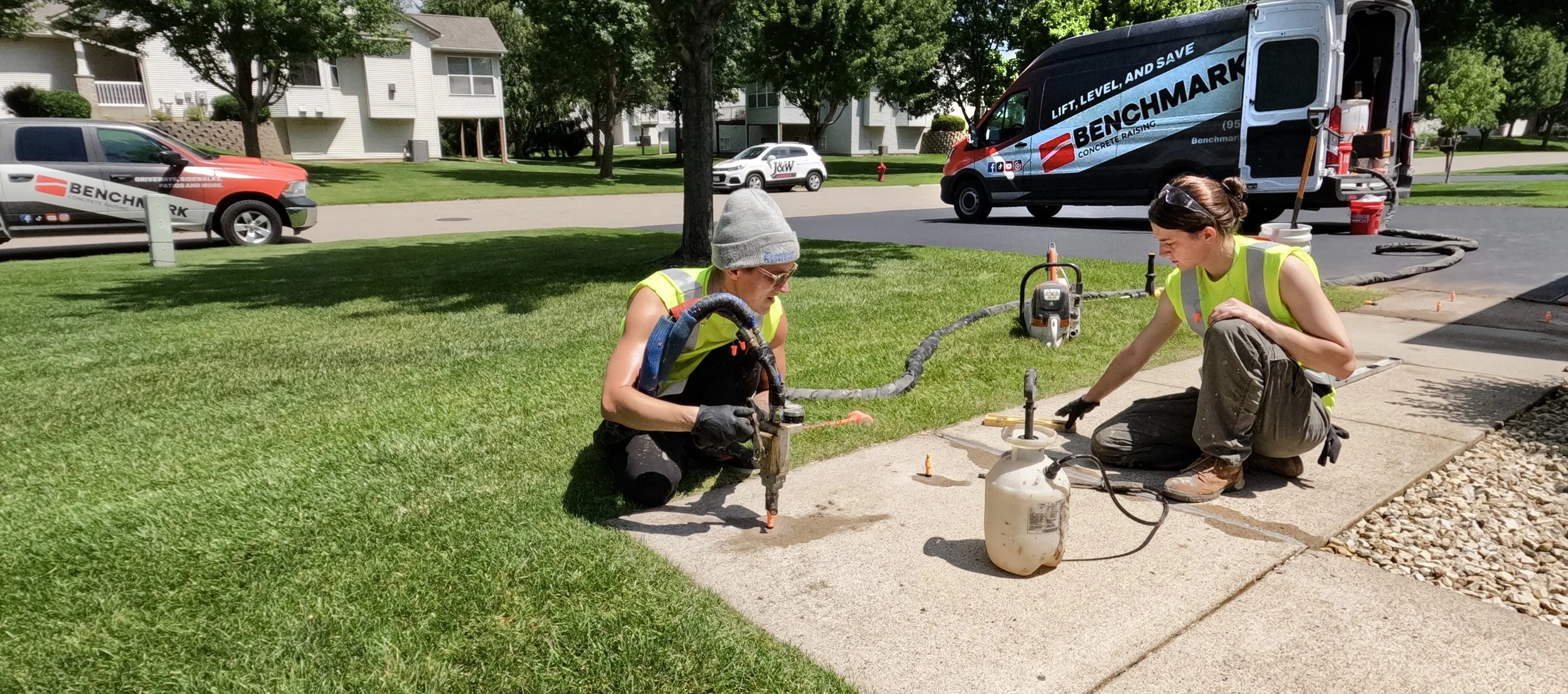
Concrete Raising & Leveling in Minneapolis, St. Paul & Twin Cities Suburbs
We lift and level sunken sidewalks, driveways, patios, steps, and garage aprons using polyurethane foam. Homeowners across the Twin Cities choose Benchmark to fix settled concrete without the cost and mess of replacement.
Frequently Asked Questions About Polyurethane Concrete Leveling
1. What is polyurethane concrete raising (polyjacking)?
Polyurethane concrete raising is a method of lifting and leveling sunken concrete by injecting a high-density expanding foam underneath the slab. The foam fills voids, stabilizes the soil, and raises the concrete back into place.
2. How does polyjacking work?
Small holes are drilled into the concrete, and liquid polyurethane foam is injected beneath the slab. As the foam expands and hardens, it lifts the concrete and supports it from below.
3. What are the advantages of polyjacking over mudjacking?
- Smaller drill holes
- Faster cure time (often same-day use)
- Lightweight material that won’t over-compact soil
- Water-resistant, closed-cell foam
- Long-lasting support
4. How long does polyurethane concrete raising last?
When properly installed, polyurethane foam repairs can last 20 years or more and often match the remaining lifespan of the concrete itself.
5. Is polyurethane concrete raising environmentally friendly?
It can be a more eco-conscious option because it avoids demolition and replacement. Less concrete waste, fewer truckloads, and reduced material use make it a greener repair solution.
6. What types of concrete surfaces can be polyjacked?
Polyjacking works best on intact slabs such as sidewalks, driveways, patios, walkways, garage aprons, pool decks, and steps.
7. What are the potential drawbacks or limitations of polyjacking?
- Not suitable for severely cracked or broken slabs
- Requires professional equipment and experience
- May not be ideal for extremely heavy industrial loads
8. How much does polyurethane concrete leveling typically cost?
Pricing varies by project, but polyurethane concrete leveling usually costs significantly less than replacement. Final cost depends on slab size, settlement depth, and site access.
9. Does Benchmark Concrete Raising offer free estimates?
Yes. Benchmark Concrete Raising provides free estimates so homeowners can understand their options and pricing before committing to a repair.
10. What areas does Benchmark Concrete Raising serve?
We serve Minneapolis, St. Paul, and surrounding Twin Cities suburbs. Contact us to confirm service availability in your area.
11. What concrete surfaces can Benchmark Concrete Raising repair?
We specialize in lifting and leveling sidewalks, driveways, patios, garage aprons, and steps where the concrete is settled but still structurally sound.
12. Is polyurethane concrete raising environmentally friendly?
Yes. Repairing concrete instead of replacing it reduces landfill waste and material use while extending the life of existing slabs.
13. How long does the concrete leveling process take?
Most projects are completed in just a few hours, and many surfaces can be used the same day after cleanup.
14. Can you explain polyurethane concrete raising in simple homeowner language?
We inject foam under your sunken concrete, the foam expands, fills empty space, and gently lifts the slab back to level — then we patch the holes and clean up.
15. Are eco-friendly concrete leveling services available in Minneapolis?
Yes. Polyurethane concrete leveling is a lower-waste alternative to replacement and is available throughout the Twin Cities through Benchmark Concrete Raising.
16. Can polyurethane concrete raising fix uneven garage floors?
In many cases, yes — especially for garage slabs that have settled near edges or aprons. We evaluate each situation to ensure it’s a safe solution.
17. How can I fix a sunken driveway without replacing it?
If the driveway is intact, polyurethane foam leveling can lift and stabilize it without demolition, saving time and money compared to replacement.
18. Why does concrete settle but not always need replacement?
Concrete often settles due to soil movement or erosion underneath — not because the slab failed. If the concrete is intact, lifting it can restore safety and function.
19. How much does it typically cost to level a sidewalk using polyurethane foam?
Most sidewalk leveling projects fall between $500–$1,500, depending on the number of slabs, settlement depth, and access.
20. What are the benefits of polyurethane foam injection for patios?
- Fast installation
- Minimal disruption
- Improved drainage away from your home
- Lower cost than replacement
- Long-lasting stabilization